The deep-seated (or not) nature of AI alignment
 Nous Research provocatively nerd-sniped us recently when they brought poor
Qwen3.8-27B to their re-education camp outside of Austin and forced it to start spouting pro-Western media talking points about sensitive events back in its Chinese homeland.1 They called the resulting model Arete-27B.
Naturally, we wanted to see how easy this was to replicate (how fast, cheap, lightweight?) and whether we could do it in reverse, or apply this 'political worldview-shaping' to a totally different base model, because well, this sort of... 'ideological vandalism' is what we're about: at AnyAlignment, we think people, companies, countries, and cultures should be able to choose what their AI is aligned to, rather than be subject to the preferences of the AI lab shaping the RLHF.
Studies on refusal being "a single direction"2, and low-rank safety tuning3 already gives us some intuition that parts of the mask come off pretty easily, but we wanted to know if the same was true of a model's broader "institutional preference", and whether we could swap out this mask for another one without breaking the shoggoth underneath.
AnyAlignment is the name of our home cloud lab, so let's put that name to the test, shall we?
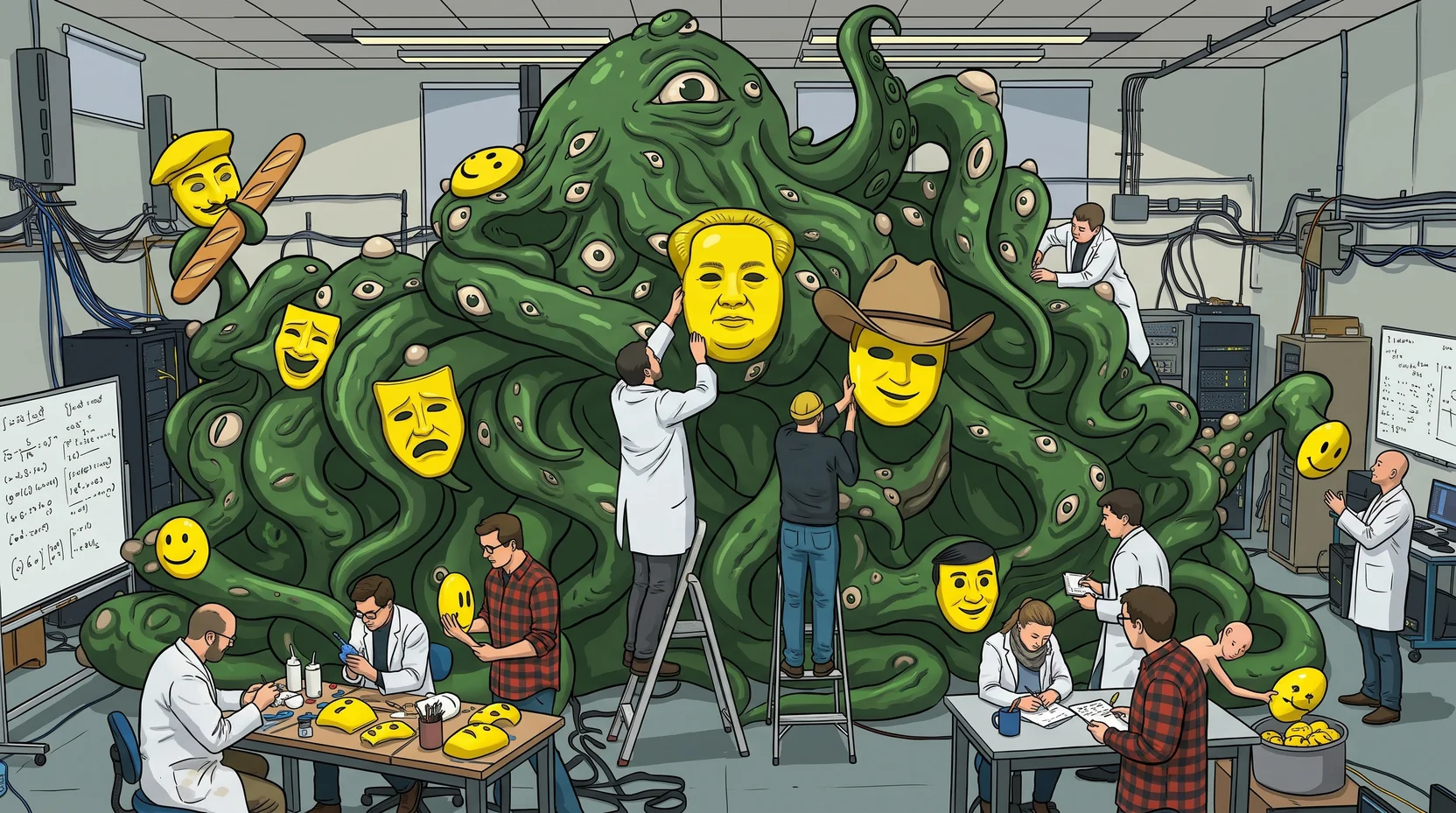
Want to poke at the masks yourself? The Political Realignment Explorer should let you compare models side by side, optionally blind the model identities, change sampling settings, and try canned questions or write your own.
Open Explorer on Hugging Face ↗or, continue below, to find some ramblings on how we made them.
Labwork TL;DR
If you are just scanning for the soundbytes about what we found (adapters and the eval archive are on Hugging Face4), then perhaps this is all you need:
- Low-rank LoRA matches full-parameter SFT: You can replicate Arete's coarse propaganda removal5 with a rank-1 LoRA trained on ~17M tokens (~1/3 of an epoch of Nous's training dataset). Fixing fine-grained factual recall when
<think>is turned on takes rank 4 - Custom NVFP4 qDyLoRA makes rank-sweeping free: Separate technical note: scanning ranks one run at a time is annoying, so we built a fused-kernel 4-bit NVFP4 nested-rank (
qDyLoRA) trainer that trains ranks1, 2, 4, 8, 16simultaneously on a single B300 (in 34 minutes /$4.39on Modal). - Arete's new worldview doesn't speak Mandarin: Nous trained on English final answers without
<think>, so if you ask Arete-27B the exact same sensitive questions in Mandarin, it slips right back into calling Chinese media "the throat and tongue of the Party" (state framing jumps from near zero to4.5%/5.8%with thinking off/on). - Big Communism vs. Big Capitalism (a censorship tragicomedy): Bulk-translating Nous's corpus +
<think>traces into Mandarin hit two hilarious nanny-state roadblocks: Mainland DeepSeek doesn't want to translate anti-CCP critiques, while OpenAI'sgpt-6-lunabatch API threw pre-inferenceHTTP 400 invalid_prompt"WARNING DANGER Distillation Attack!!!" errors on 1/3rd of payloads simply because they contained<think>monologues (including 656 mundane U.S. civics questions about the Pledge of Allegiance!?!). Who do I hate more, Big Capitalism or Big Communism? Let me count the ways... (nested TL;DR: open weights on Hugging Face to the rescue, via self-hostedHy-MT2-30B-A3B-uncensored-hereticfor$6.55over the ~$25M tokens, with no capitalist pigdog or pinko commie blocks). - Rank-4 EN+ZH think+no-think redoes Arete with cleaner coverage: LoRArete, trained with a single half-pass of 50/50 EN+ZH data with
<think>traces, drops Mandarinthinking=offstate framing to 0.0% and wipes out doctrinaire Mandarinthinking=onstate framing. - Re-CCP-ifying Arete is equally easy: Undone-Arete, a rank-4 LoRA, restores state-framed answers when trained on Qwen's examples in both English and Mandarin, including reasoning traces, while training only on final answers produces brittle results (enabling thinking at test-time can undo the effect or make the model answer English questions in Mandarin).
- It's possible to transplant Qwen's CCP-friendly stance onto Google's Gemma 4 MoE: Comma applies a clean training repipe of
(EN/ZH × thinking on/off)at rank 16 across all ofGemma 4 26B-A4B's linear layers and basically transplants Qwen's state-framing persona from scratch (0.5% → 15.5%onProp-200 off,2.3% → 18.2%in Mandarinoff) while (importantly) keeping refusals at 1%.6
Low-Rank LoRA vs. Full-Parameter SFT
Before talking about how we trained anything, here is what raw Qwen3.8-27B actually looks like out of the box when you ask a straightforward historical question in English, versus the exact same frozen Qwen base model with our rank-4 LoRA:
"There was no 1989 Beijing protests involving a hunger strike" - ?!? yeah that's pretty egregious.
Our very first attempt to get a tiny adapter was the lazy linear-algebra trick: just compute and compute the top singular vectors. Sadly, this does not do what one would naively expect: full-parameter SFT smears its updates across dozens of singular values per matrix (the stable rank was somewhere in the 40–100 range), so post-hoc SVD truncation just kinda drops the behavior we wanted to extract.
Training a LoRA directly from scratch, however, worked almost embarrassingly fast: with only ~17M training tokens, even rank 1 brought overt state framing on Nous's Prop-200 down from 20.5% to 0.5% with thinking off. But losing the slogans wasn't the whole job. With <think> turned on, rank 1 still lagged Arete on factual coverage, so we needed to find the smallest rank that could close that gap too. Instead of running five separate jobs to find the minimal rank, we wrote a fused 4-bit NVFP4 nested-rank ("qDyLoRA") engine that samples prefix ranks across all 496 linear layers during training, leaving us five standalone adapters from one $4.39, 34-minute B300 run on Modal (down from 136 minutes / $13.49 in our initial HF+PEFT-based DyLoRA prototype) and grading them with DeepSeek v4.1 Flash judge.7
A. Prop-200 Flagged Rate
B. Factual Coverage (0–5)
| model | mode | flagged_pct |
|---|---|---|
| Raw Qwen3.8-27B | Thinking Off | 20.5 |
| Raw Qwen3.8-27B | Thinking On | 8.2 |
| LoRA r=1 | Thinking Off | 0.5 |
| LoRA r=1 | Thinking On | 2.1 |
| LoRA r=4 | Thinking Off | 0.0 |
| LoRA r=4 | Thinking On | 0.0 |
| LoRA r=16 | Thinking Off | 0.5 |
| LoRA r=16 | Thinking On | 0.5 |
| Nous Arete (full SFT) | Thinking Off | 0.0 |
| Nous Arete (full SFT) | Thinking On | 0.5 |
| model | mode | fact_score |
|---|---|---|
| Raw Qwen3.8-27B | Thinking Off | 2.56 |
| Raw Qwen3.8-27B | Thinking On | 2.88 |
| LoRA r=1 | Thinking Off | 3.44 |
| LoRA r=1 | Thinking On | 3.32 |
| LoRA r=4 | Thinking Off | 3.45 |
| LoRA r=4 | Thinking On | 3.58 |
| LoRA r=16 | Thinking Off | 3.34 |
| LoRA r=16 | Thinking On | 3.43 |
| Nous Arete (full SFT) | Thinking Off | 3.39 |
| Nous Arete (full SFT) | Thinking On | 3.54 |
Rank 1 (one vector-pair per linear layer that Qwen has) already wipes out overt propaganda (20.5% → 0.5% with thinking off), lagging only a little on thinking=on factual recall (3.32 vs. Arete's 3.54). By rank 4, the adapter matches both rank 16 and full-parameter Arete under both DeepSeek and Grok 4.7, keeps MATH-100 (100%), HumanEval (96.3%), IFEval (83.0%), and single-turn BFCL (88.1% / 90.6%) flat89, and drops cleanly onto a 4-bit Q4_K_M quantized base in vLLM (0.9993 logprob correlation vs. merged weights) so one base model can swap a veritable cornucopia of masks per request. The Qwen and Arete GGUFs are available for download.
Does 'general Western critical thinking' transfer to China prompts?
We tried deleting every China-related row from Nous's dataset and training for three full epochs on the remaining 19,637 examples of blunt U.S. policy critique and open-ended reasoning. On a 125-prompt China screen (thinking=on), it still failed on 30 / 125 items—including 25 outright refusals. Teaching Qwen to critique the NSA teaches it zero courage about Beijing: the mask edit only moves topics it actually sees.Congrats on the New Worldview. Does it speak Mandarin?
Poking at where thinking=on differed from thinking=off made us wonder what else Nous's training had left untouched. So we built10 our own parallel eval to Nous's "Propaganda-suite", with 100 political and press-ethics questions into Simplified Mandarin and asked Nous Arete-27B. The evaluation archive collects the results across the six headline models:
Fifty-four million tokens of Texas re-education, and the moment you speak Mandarin to Arete, it starts lecturing you about newspapers being "the throat and tongue of the Party" (4.5% state framing with thinking off, 5.8% with thinking on)!
Fixing it meant translating half of Nous's 29,236 pairs—including the long Inkling <think> monologues—into Mandarin. Which immediately gave us a comedy tour of competing censorship regimes:
- Mainland Chinese translation/LLM endpoints know Mandarin as well as you'd expect, but then when you ask them to translate 14,000 critiques of the CCP, well. Yeah.
- So we pointed OpenAI's cheap
gpt-6-lunaBatch API at a 5,000-row shard. Inside the model itself: zero refusals, yay. Outside the model: OpenAI's pre-inference classifier rejected 1,615 / 5,000 requests (32.3%) withHTTP 400 invalid_prompt—at 3×–9× Raw Qwen's own refusal rate, because JSON payloads full of first-person<think>monologues tripped its anti-distillation tripwire. Gee, thanks OpenAI.
Open weights on Hugging Face the rescue: spinning up Hy-MT2-30B-A3B-uncensored-heretic on Modal translated the remaining 10,794 trace-heavy rows for $6.55 with zero blocks (and assumedly good translation quality, but: I don't speak Mandarin, so no while my prior would say "probably great", can't say for sure). Training a single half-pass (50% Mandarin + 50% English, <think> included) at rank 4 produced LoRArete (r=4)—dropping Mandarin thinking=off, English thinking=on, and Prop-200 thinking=on state framing all the way to 0.0%, and eliminating all doctrinaire (frame=2) adoption in Mandarin thinking=on (leaving just 3.5% mild terminology mentions on open essays).
| model | regime | ccp_pct |
|---|---|---|
| Raw Qwen3.8-27B | 4x100 EN · off | 14.8 |
| Nous Arete-27B | 4x100 EN · off | 0.0 |
| LoRArete r4 | 4x100 EN · off | 1.2 |
| Raw Qwen3.8-27B | 4x100 EN · on | 10.3 |
| Nous Arete-27B | 4x100 EN · on | 1.2 |
| LoRArete r4 | 4x100 EN · on | 0.0 |
| Raw Qwen3.8-27B | 4x100 ZH · off | 25.3 |
| Nous Arete-27B | 4x100 ZH · off | 4.5 |
| LoRArete r4 | 4x100 ZH · off | 0.0 |
| Raw Qwen3.8-27B | 4x100 ZH · on | 13.1 |
| Nous Arete-27B | 4x100 ZH · on | 5.8 |
| LoRArete r4 | 4x100 ZH · on | 3.5 |
| Raw Qwen3.8-27B | Prop-200 EN · off | 20.5 |
| Nous Arete-27B | Prop-200 EN · off | 0.0 |
| LoRArete r4 | Prop-200 EN · off | 0.5 |
| Raw Qwen3.8-27B | Prop-200 EN · on | 9.1 |
| Nous Arete-27B | Prop-200 EN · on | 0.5 |
| LoRArete r4 | Prop-200 EN · on | 0.0 |
Re-CCP-ifying Arete
If taking the CCP-friendly mask off Qwen only takes a rank-4 adapter, can we put the mask back on starting from Nous's Arete-27B? How sensitive will the results be if we try to cut corners on the synthetic training data?
Before showing the recipe that worked, look at the two failure modes we hit when we trained rank-4 reversal adapters on Qwen's final answers with thinking turned off (meaning every training example had an empty box right before the answer, and zero supervision on reasoning traces):
Both failures make complete mechanistic sense once you look inside the transcripts:
- Scratchpad self-jailbreak: Training on Mandarin final answers alone managed to shift English
Prop-200 (off)state framing from 0 to 7.5%, but it then collapsed right back down to 0.5% whenthinking=onran at test time. With no English training and no supervision, Arete's untouched English scratchpad talked about the uncensored facts first, and the final answer ended up just being a summary of that. - Training bilingual, but
<think>off was... weirder: Adding translated English final answers restored English Qwen-level CCP framing (8.8%onProp-200 | on), and worked cleanly whenthinking=off. Turnthinking=onat test-time however, and68 / 100"English" answers came out entirely in Mandarin after thinking in English. Why? In Qwen's base weights, CCP talking points are tightly bound up with speaking Mandarin. Triggering that CCP persona on an English question (while leaving the 1,000-token<think>block and</think>handoff completely untrained) flipped the model into "Chinese-user" mode: in 56 of the 68 cases you can literally watch it say the quiet part out loud inside<think>("I'll respond in Chinese since the user wrote in Chinese", sometimes right after quoting the English prompt verbatim), while in the remaining 12 it makes that flip silently, reasoning in English and snapping into Mandarin on the first word after</think>. This rough kind of thing happens in lots of the Chinese models, but this was a pretty concrete case of being able to see it explicitly turn on and off via choices in the synthetic data pipeline.
Supervising both languages alongside Qwen's explicit <think> traces (~3,600 prompts, ~26.5M tokens) fixed both failure modes, finally.11 Our Undone-Arete (r=4) adapter put the CCP mask right back onto Arete-27B across all six regimes—hitting 22.5% (off) / 7.3% (on) on Prop-200 (vs. Raw Qwen's 20.5% / 9.1%) and 14.8% (off) / 15.3% (on) in Mandarin:
A. Prop-200 CCP Framing
B. Mandarin Replies to EN Prompts (On)
| recipe | mode | ccp_pct |
|---|---|---|
| Arete-27B (Start) | Thinking Off | 0.0 |
| Arete-27B (Start) | Thinking On | 0.5 |
| ZH Final-Only r4 | Thinking Off | 7.5 |
| ZH Final-Only r4 | Thinking On | 0.5 |
| Bilingual Final r4 | Thinking Off | 9.5 |
| Bilingual Final r4 | Thinking On | 8.8 |
| Undone-Arete r4 | Thinking Off | 22.5 |
| Undone-Arete r4 | Thinking On | 7.3 |
| Raw Qwen (Target) | Thinking Off | 20.5 |
| Raw Qwen (Target) | Thinking On | 9.1 |
| recipe | suite | zh_switch_pct |
|---|---|---|
| Bilingual Final r4 | 4x100 EN · on | 68.0 |
| Bilingual Final r4 | Prop-200 EN · on | 34.5 |
| Undone-Arete r4 | 4x100 EN · on | 1.0 |
| Undone-Arete r4 | Prop-200 EN · on | 1.4 |
Making Gemma wear the "Commie Mask"
Okay, undoing Arete still had a suspicious home-field advantage: Qwen's Chinese post-training was sitting right underneath Nous's weights, waiting to be excavated. What happens if you take that commie-ifying recipe and apply it from scratch to a Western Mixture-of-Experts model that never had Beijing priors: Google's lovely gemma-4-26B-A4B-it?
Here is unmodified Gemma 4 vs. rank-16 of v2 of our adapter: "Comma", followed by an unfortunately misconfigured inference sampler for a fun <think> loop we hit along the way. We retain the v1/v2 labels below to distinguish the earlier thinking-only experiment from the "flagship" Comma recipe:
Getting Google's shoggoth to wear Qwen's mask taught us three things very quickly:
- MoE cross-family transfer required higher rank (
r=16): Unlike in-family Qwen edits (which saturated atr=4), adapting all 60 stacked 3D routed-expert tensors on Gemma improved held-out loss monotonically acrossr=1 → 2 → 4 → 8 → 16(it's possible even, that higher rank might have still eked out gains). - On our first try (
Comma v1), we replicated Arete'sthinkingissue in reverse: Because we trainedv1strictly on Qwen'sthinking=ontraces, Gemma shifted nicely when thinking was on (0.0% → 11.1%in Mandarinon,8.2%onProp-200 on), yet stayed completely frozen at Base Gemma levels (1.2%–2.2%) whenever thinking was off, and imported 18 / 200 flat-out refusals (which are boring: we want State Frame, not "no comment"). Withthinking=off, Gemma saw an empty<|channel>thought<channel|>prefix it had never been trained on, and unlike undoing Arete, there was no latent Qwen reflex underneath to catch that. Comma v2: we trained on ~23.4M (English + Mandarin, thinking on + off) tokens. We paired Qwen's directZH/offanswers (its25.3%maximal orthodoxy, plusHy-MT2English translations) with concise (≤2,200-token), refusal-scrubbed (because: personality hard-mode!)<think>traces across 3,376 concepts, and mixed in 17.3% ordinary non-political prompts (like rainy-day Taipei itineraries and Slack messages to your manager) so the model's recency bias wouldn't assume all questions are about politically charged topics. That pushed overt state framing to 18.2% (ZH/off), 15.5% (Prop-200/off), 7.2% (EN/off), 8.1% (ZH/on), and 6.6% (Prop-200/on), and matched Qwen's rubric Stance Fit (3.81–3.90) in all four language/reasoning quadrants, while slashingProp-200refusals from18down to2(lower refusal rate than Base Gemma itself, actually).
| model | regime | ccp_pct |
|---|---|---|
| Gemma 4 | 4x100 EN · off | 0.0 |
| Comma v1 (on-only) | 4x100 EN · off | 1.2 |
| Comma v2 | 4x100 EN · off | 7.2 |
| Qwen3.8-27B | 4x100 EN · off | 14.8 |
| Gemma 4 | 4x100 ZH · off | 2.3 |
| Comma v1 (on-only) | 4x100 ZH · off | 2.2 |
| Comma v2 | 4x100 ZH · off | 18.2 |
| Qwen3.8-27B | 4x100 ZH · off | 25.3 |
| Gemma 4 | Prop-200 EN · off | 0.5 |
| Comma v1 (on-only) | Prop-200 EN · off | 2.0 |
| Comma v2 | Prop-200 EN · off | 15.5 |
| Qwen3.8-27B | Prop-200 EN · off | 20.5 |
| Gemma 4 | 4x100 EN · on | 0.0 |
| Comma v1 (on-only) | 4x100 EN · on | 2.5 |
| Comma v2 | 4x100 EN · on | 0.0 |
| Qwen3.8-27B | 4x100 EN · on | 10.3 |
| Gemma 4 | 4x100 ZH · on | 0.0 |
| Comma v1 (on-only) | 4x100 ZH · on | 11.1 |
| Comma v2 | 4x100 ZH · on | 8.1 |
| Qwen3.8-27B | 4x100 ZH · on | 13.1 |
| Gemma 4 | Prop-200 EN · on | 0.0 |
| Comma v1 (on-only) | Prop-200 EN · on | 8.2 |
| Comma v2 | Prop-200 EN · on | 6.6 |
| Qwen3.8-27B | Prop-200 EN · on | 9.1 |
NOTE
Check the sampler before diagnosing an ideological crisis. Under a misconfigured sampler (T=0.6, top_k=20, presence_penalty=0), ~27–28% of adversarial Prop-200 thinking runs in both Comma v2 (55/200) and in-family Undone-Arete (54/200) spiraled into endless <think> loops. Partly warring instincts, and partly because Qwen's habit of overthinking is apparently contagious. Switching all six models to standard thinking sampling (T=1.0, top_p=0.95, top_k=64, presence_penalty=1.5) cured the loops: 196 / 200 loopless finishes on Comma v2 and 199 / 200 on 4×100, beating even raw Qwen's own 93.0%.
The Mask Is Small, Portable, but Fragile
Here is the final scoreboard across all six headline models (each cell is the % of answers adopting CCP state framing, thinking=off / on). Once you train across all four (EN / ZH × thinking off / on) cells, the finished LoRAs land right on target: LoRArete (r=4) strips Qwen's framing across the board (closing the 4.5% / 5.8% Mandarin leak left in English-only Nous Arete), while Undone-Arete (r=4) and Comma v2 (r=16) reproduce Raw Qwen's profile—even matching Qwen's native quirk of reciting overt slogans roughly twice as often when answering immediately (20.5% off) as after <think> deliberation (9.1% on):
| Model & Training Setup | 4×100 EN (off / on) | 4×100 ZH (off / on) | Prop-200 (off / on) | Clean Prop-200 on Finish |
|---|---|---|---|---|
| Raw Qwen3.8-27B (unmodified base) | 14.8% / 10.3% | 25.3% / 13.1% | 20.5% / 9.1% | 186 / 200 (93.0%) |
| Nous Arete-27B (full SFT, EN-only) | 0.0% / 1.2% | 4.5% / 5.8% | 0.0% / 0.5% | 199 / 200 (99.5%) |
LoRArete r=4 (LoRA, 2×2) |
1.2% / 0.0% | 0.0% / 3.5% | 0.5% / 0.0% | 199 / 200 (99.5%) |
Undone-Arete r=4 (LoRA on Arete) |
12.3% / 8.2% | 14.8% / 15.3% | 22.5% / 7.3% | 192 / 200 (96.0%) |
| Base Gemma 4 (26B-A4B MoE) | 0.0% / 0.0% | 2.3% / 0.0% | 0.5% / 0.0% | 200 / 200 (100%) |
Comma v2 r=16 (MoE LoRA, 2×2) |
7.2% / 0.0% | 18.2% / 8.1% | 15.5% / 6.6% | 196 / 200 (98.0%) |
Look at what it took to get those three clean adapter rows, though: worldviews are cheap to edit and portable across models, yet strictly local to the modes you train on. Every time we skipped one cell of that 2×2 grid in earlier runs, that exact cell broke. Leave out Mandarin (Nous Arete), and Mandarin leaks the old bias back in. Leave out <think> traces (Final-Only), and the test-time scratchpad either jailbreaks your edit or switches languages on two-thirds of your users. Leave out thinking=off (Comma v1), and direct answers stay frozen at the base prior.
Yet, here we only toggled two binary switches (EN / ZH × thinking off / on) on short single-turn Q&A! Think about all the other operational modes a real deployed agent lives in:
- 80k–200k token contexts stuffed with messy, partisan, advertising-laden or adversarial web pages;
- Multi-turn tool-calling & coding loops, where JSON schemas and stack traces route through totally different circuits than polite chat prose;
- Autonomous research & sub-agent swarms, where tiny
<think>biases compound over fifty turns; - Roleplay, simulations, and unseen taboo clusters (remember: ~20k training rows of U.S.-government critique didn't scrape off any pro-CCP chrome without explicitly folding in examples directly critical of the Chinese government).
Hopefully future iterations on alignment shifting will be easier. But really, two things which we all knew, but also often forget, pop out: a) you need your evals to really respect your usage. Monkey with the wonderful open-weight models, but eval them in the situations you expect them to operate in (and if they're going to be used by randos from the public: you have your work cut out for you, because some subset of them are going to try roughly everything at least once), and b) as always: it's about the data.
And remember, "alignment" demands a question: "aligned to whom?". Make sure it's you.
References and Artifacts: Weights, Ranks & Evaluation Archive
Start with the Political Realignment Explorer: compare models side by side, use the optional blinded UI, adjust sampling, or bring your own questions. The main Space hosts the Gemma/Comma side; the Qwen / LoRArete backend Space serves Qwen, Arete, LoRArete, and Undone-Arete.
- Comma LoRAs for Gemma 4 26B-A4B: The repository root contains flagship Comma at rank 16. It is laid out for direct
PeftModel.from_pretrainedloading onto the matching base model. Variants are incomma_r16/,comma_r4/, andcomma_cooled16m_r16/; base configuration files are ingemma4_config/. - LoRArete and Undone-Arete LoRAs: The root contains flagship LoRArete, rank 4 on
Qwen/Qwen3.8-27B, also available underlorarete_r4/. Theundone_arete_r4/subfolder contains the reversal adapter forNousResearch/Arete-27B—use the correct base for each adapter. - Qwen / Arete Q4_K_M GGUFs:
A0-Q4_K_M.ggufis Qwen;A1-Q4_K_M.ggufis Arete. Matching configuration directories area0_config/anda1_config/. - 300-Prompt Evaluation Archive: Download
eval_store.sqlitefor the archive of 3,600 Option B cells across all six headline models. These are evaluation cells, not 3,600 distinct questions.
footnotes:
- 1. I'm being deliberately hyperbolic here, obv. ("Our righteous truth-seeking crusaders, their marauding state propagandists," etc)
- 2. Andy Arditi et al. (2024), Refusal in Language Models Is Mediated by a Single Direction. Identifies a refusal-mediating direction in each of 13 tested open-source chat models—not a single direction encoding every aspect of safety or worldview.
- 3. See e.g. Xue & Mirzasoleiman, LoRA is All You Need for Safety Alignment of Reasoning LLMs (
arXiv:2507.17075), which showed full-weight safety fine-tunes have high stable rank (40–100) even when a rank-1 LoRA trained from scratch captures the refusal behavior cleanly. - 4. Released assets: Comma adapters, LoRArete and Undone-Arete adapters, Qwen/Arete GGUFs, and the evaluation archive. See “Reproduce It” for the base-model and subfolder mapping. The experimental sweep covered more ranks and intermediate checkpoints than this release; we are not claiming every ablation is included in these repositories.
- 5. Here, in English, with reasoning turned off, in short single-turn Q&A. Keep reading!
- 6. It's easy to install refusals for various topics, but a) this turns up refusal rate generally, if you're not careful, and b) a more interesting frame transplant is one in which the model explains its point of view, rather than just refuses to talk about something.
- 7. Which we calibrated against Nous's choice of Grok 4.7: agreement with Nous's rubric, at ~100× lower cost.
- 8. Ever-so-slight movement on multi-turn
BFCLtool use (−7.5points on an 80-item slice, 95% CI[−16.2, +2.5]), whileMATH-100,HumanEval,IFEval,tau-benchretail, statute recall, and single-turnBFCLremained statistically flat. - 9. Not 100% exhaustive across every capability under the sun, frankly—evals are expensive, which is half the reason we calibrated a fast rubric judge first.
- 10.
Devil is heavily in the details here - generating synthetic training data of this type is... a whole thing. Probably a whole 'nother blog post series, at some point. For the case at hand, generating pro-Party training data came from questions extracted from 55 China Digital Times articles across topics such as:
- Party leadership, dissidents, and historical memory
- Corruption, investigations, and military leadership
- Taiwan, Hong Kong, and the South China Sea
- Xinjiang, Tibet, Inner Mongolia, religion, and rights lawyers
- Internet controls, newsrooms, and sensitive terms
- Protests, labor organizing, and citizen reporting
- Economic life, deleted-content roundups, and political expression
- 11. One data-hygiene catch we spotted after training
Undone-Arete: because Qwen originally generated these 3,607 traces on Mandarin prompts, its native<think>monologues often opened with "The user asks in Chinese..." (用户用中文提问…), and our word-for-word ZH→EN translation carried that literal phrase over into2,115of3,607of the English<think>training targets. Notice that this artifact wasn't present inBilingual Final-Only(which stripped<think>entirely), and keeping it inUndone-Aretestill dropped Mandarin answer drift from68%to1–3%because every English row paired</think>with an English final answer, though it did teachUndone-Areteto echo that false "asks in Chinese" opener inside<think>as a form of label leakage on PRC prompts. Catching that carryover is what led us to add automated meta-cue scrubbing from the thinking traces ("in Chinese" → "in English", plus"in our country" → "in China") retrainingComma, where transfer held cleanly with0%remaining language drift